


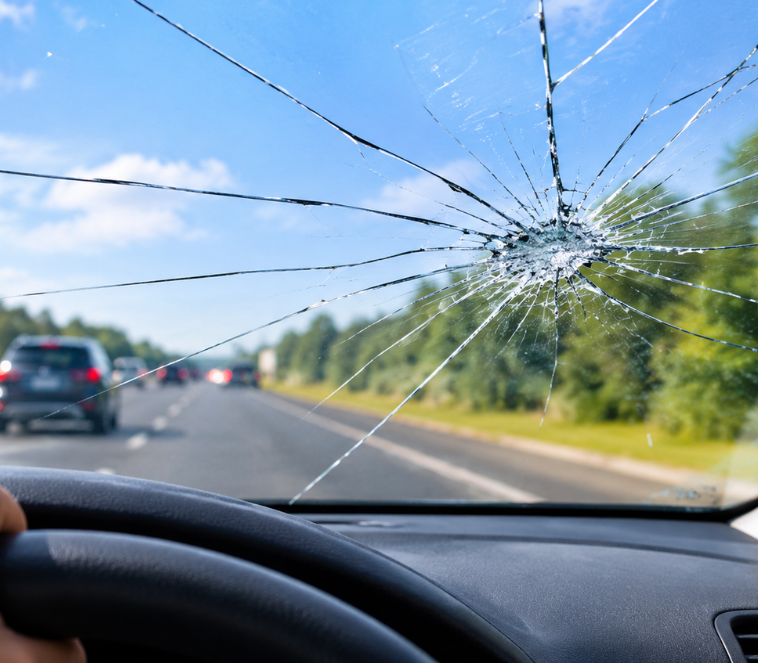
You’re driving along the 401 when a thin line races across your windshield. Nothing hit the glass. You didn’t do anything different. So what just happened?
Windshield crack spreading looks sudden, but it rarely is. A chip or crack is a weak spot that has been carrying stress since the day it appeared. Then one more bump, or one more blast of heat or cold, tips the glass over the edge.
If you already have a chip or crack and you’re deciding whether to fix it, this guide is for you. We’ll explain why cracks grow, what to do if one spreads while you’re on the road, and when a repair still works.
Here’s the truth: waiting is the choice that costs you the most. At Auto Glass Canada, we’ve been repairing windshields across the GTA since 2001, and we’d much rather fix a small chip today than replace a whole windshield next month.
Can a Windshield Crack Spread Suddenly While You’re Driving?
Yes. A damaged windshield stores stress around the chip or crack. A pothole, a temperature swing, or strong wind pressure can push that stress past its limit, and the crack can run several centimetres in seconds. It looks sudden, but the weak spot was there long before.
Think of a chip as a loose thread in a sweater. It holds for a while, then one tug unravels it. Safelite notes that a chip you can repair today can become a full-length crack within days. Temperature changes, road vibration, and even a slammed car door can all be the trigger.
Highway driving adds even more risk. High speeds increase wind pressure on the glass, which is one reason cracks so often run while you’re behind the wheel.
What Causes Windshield Crack Spreading in the First Place?
Windshield crack spreading comes down to three main triggers: temperature swings, road vibration, and moisture. Each one adds stress to glass that is already damaged. Speed adds wind pressure, so a weak crack can grow faster on the highway than on quiet side streets.
Temperature swings
Heat makes glass expand and cold makes it contract, and that movement widens existing damage. Uneven heating or cooling causes thermal shock. Our guide on why windshields crack in summer shows how a hard blast of AC can do it. In winter, the defroster can also make damage spread.
Road vibration
Potholes, rough roads, and slammed doors all shake the glass. Each jolt adds a little more stress at the tip of the crack.
Moisture
Rain and humidity can seep into a crack and weaken the glass around it, especially when the temperature keeps changing.
Warning Signs Your Crack Is About to Grow
Cracks often give you a heads-up before they run. Check your glass in daylight and watch for these signs:
- The crack looks longer than last week. Snap a photo every day or two. If it’s growing, you’ll see it.
- New lines branch off a chip. The arms of a star-shaped chip can extend quickly when the glass is stressed.
- The crack heads for the edge or your line of sight. Edge cracks are the most structurally risky, and any damage in the driver’s main viewing area is a problem right away.
What Should You Do If a Windshield Crack Spreads While You’re Driving?
Stay calm and keep both hands on the wheel. Ease off the gas, slow down smoothly, signal, and pull over when it’s safe. Don’t slam the brakes or crank the defroster. Your windshield has a plastic layer between two sheets of glass, so it should hold together while you stop.
Once you’re parked, look at the damage. If the crack crosses your line of sight, don’t keep driving. Ontario’s Highway Traffic Act, section 74(1) says your windshield must give you a clear view to the front and sides.
Not sure if it’s safe to continue? Call us. Our mobile technicians come to you, so you don’t have to drive on a damaged windshield.
Stop Windshield Crack Spreading Before It Costs You More
The good news is that early action works. Safelite says it can usually repair damage under 6 inches long when the impact point is smaller than a dime. At Auto Glass Canada, we also repair chips and cracks up to about 6 inches, often in under an hour. Once a crack grows past that, or reaches the edge, replacement is usually the only safe choice. Our repair vs. replacement guide shows how we decide.
Waiting puts more than your wallet at risk. In a frontal crash, the passenger airbag uses the windshield as a backstop, and a properly bonded windshield adds stiffness to the roof in a rollover. A cracked or chipped windshield supports the roof less, so fixing damage early protects that safety job too.
The cost is often easier than you’d expect. Many policies cover chip repair with little or no deductible, and we offer direct insurance billing, so there’s no paperwork for you.